Safe prompting for kids: how to teach a child to talk to an AI
A short, practical guide to helping children ask better questions of an AI assistant — what to share, what to hold back, and the four-part prompt shape that works from age six upwards.
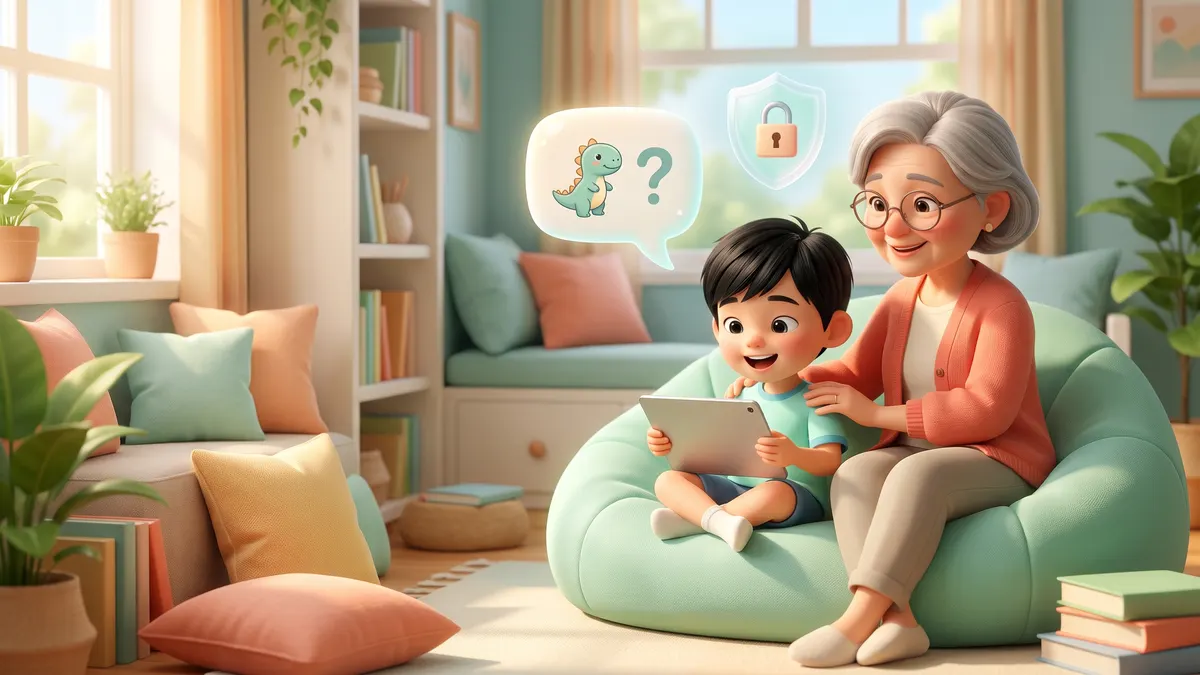
Most advice about prompting is written for adults trying to get more out of a tool. For children the goal is different and simpler: ask in a way that gets a useful answer, without handing over anything that should have stayed at home.
Those two goals turn out to be the same lesson, because a vague prompt is usually the one that leaks. “Help me with my homework” invites the assistant to ask which school, which teacher, which class. A specific prompt does not need any of that.
The four-part shape
Children as young as six can hold a four-part prompt if you give it a rhythm rather than a rule. Say it out loud together a few times and it sticks.
What I want. A verb, at the start. Explain, list, compare, check, give me ideas for.
What it is about. The actual subject, in as few words as possible. “Why volcanoes erupt.” “The water cycle.”
Who it is for. “I’m eight.” This is the part children skip and the part that changes the answer most — it moves the reply from encyclopedia prose to something they can actually use.
How long. “In three sentences.” “Just five ideas.” A length limit does more for comprehension than any other single word in the prompt.
Put together: Explain why volcanoes erupt. I’m eight. Three sentences. That is a genuinely good prompt, and there is nothing personal in it.
What stays out
Keep the list short enough to be memorised, and phrase it as a category rather than a series of separate bans. Nothing that helps a stranger find us: real full name, address, school name, where you play football on Tuesdays. No photos of anyone. No passwords, ever, of anything. Nothing private about someone else — a friend’s diagnosis, a cousin’s parents’ argument — because it was not theirs to hand over.
The single most useful test to give a child: would you say this into a microphone in the school hall? It is concrete, it is quick, and children apply it accurately, which abstract principles about “personal data” do not.
Two answers that mean “stop”
Teach the two signals that end a conversation rather than continue it.
If the assistant asks a personal question, that is the end of the exchange. Not a negotiation, not a partial answer. Stop and tell an adult.
If the reply is upsetting, frightening or simply strange, the same thing. Emphasise that they will not be in trouble and the device will not be taken away — that fear is the single biggest reason children hide bad interactions, and a hidden bad interaction is the only genuinely dangerous kind.
Practise on things they already know
The best training runs happen where your child is the expert. Ask the assistant about their favourite game, their book series, the rules of a sport they play. They will catch errors immediately, and catching an error is the moment the whole lesson lands: this thing is useful and it is often wrong, and both are normal.
Follow up with the question that makes it a habit rather than an event: “How could we check that?”
Guardrails first, freedom later
None of this replaces a bounded environment for the first few years. In KidseAI the assistant a child meets can only discuss the lesson currently on screen — it cannot free-chat, cannot browse, and cannot be steered somewhere else, so early practice happens with the fence up. The habits above are what they take with them the day it comes down.