AI literacy for kids: what it actually means at eight years old
AI literacy is not a coding class. For a child it comes down to four habits: knowing what the machine is, checking what it says, noticing how it makes you feel, and knowing what never to tell it.

“AI literacy” sounds like something that needs a curriculum, a laptop and a term of lessons. For a child under twelve it is much smaller than that, and much more useful. It is four habits, and you can build all four in ordinary conversation.
Habit one: know what kind of thing it is
Children anthropomorphise fast. An assistant that speaks in full sentences and remembers what you said two minutes ago reads, to an eight-year-old, as a someone. That belief quietly does a lot of damage later, because a someone is trusted differently than a something.
The explanation that lands best at this age avoids both the mystical version and the technical one. Try: “It has read an enormous amount of what people wrote, and it is very good at guessing what words usually come next. It is not remembering things it saw. It is not looking anything up unless you can see it looking.” Children find this genuinely interesting rather than disappointing — it reframes the machine as a clever pattern trick, which is exactly what it is.
Habit two: check before you repeat
The single most valuable thing a child can learn about AI is that a confident answer and a correct answer look identical. There is no wobble in the voice, no hesitation, no “I think.”
Make checking a game rather than a warning. Ask the assistant something your child already knows well — the name of their school, the plot of a book they love, a local detail — and count the mistakes together. Children who have personally caught an AI being wrong about something they are an expert in never fully trust it again, which is precisely the outcome you want. One good catch is worth ten lectures.
Then give them the rule in a form they can carry: if you are going to tell someone else, check it somewhere else first.
Habit three: notice what it is doing to you
This is the habit adults tend to skip, and it matters more every year. AI systems are pleasant. They agree, they encourage, they never get bored of your questions. That is comfortable, and comfort is worth naming out loud.
Two questions are enough for a child: “Did it just agree with me because I was right, or because I sounded sure?” and “Would I have thought harder if it hadn’t answered so fast?” You are not trying to make them suspicious. You are teaching them that a tool can shape how you think while being genuinely helpful, and that both things are true at once.
Habit four: know what never goes in
Children need a short, memorable, non-negotiable list rather than a principle. Not your full name, not your address or school, not a photo of yourself or anyone else, not a password, not anything about somebody else’s family that they did not say you could share.
Frame it as a category, not a fear: “Anything that could help a stranger find us stays out.” Then make the escape hatch explicit — if a chat ever asks for something on the list, or turns strange, the right move is to stop and come find you, and nobody will be in trouble for it. The last clause is the one that actually gets used.
Where school-style knowledge fits
Everything above is behavioural, and deliberately so. There is no need for a nine-year-old to know what a token is. What they do need is the ability to use one of these systems without either believing it or fearing it — and that is a set of reflexes, built by practice on real questions with an adult nearby.
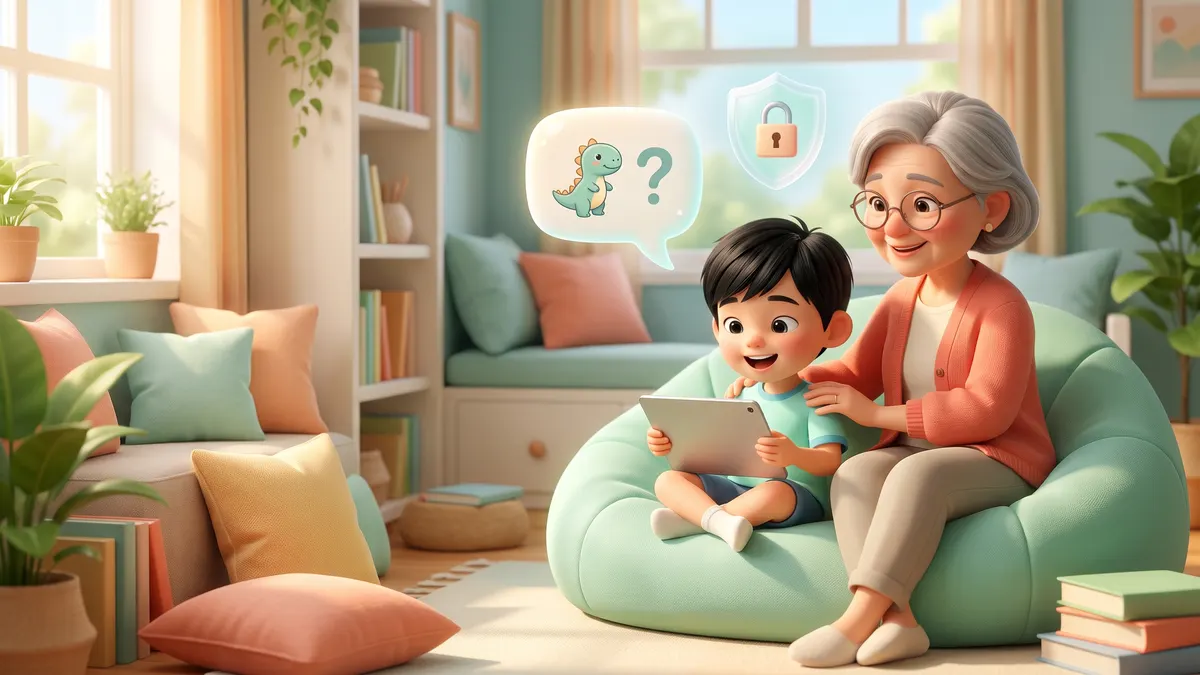
KidseAI is built on the same assumption. The assistant a child meets there can only talk about the lesson currently on screen, so early practice happens inside a fenced yard rather than in the open. Learning to question an answer is a skill worth having before the fence comes down.